
Generative AI for Legal Writing: Transform Contracts & Briefs
Cut legal writing time by 60-70% with AI. Automate contract drafting, review risky clauses instantly, and free attorneys for high-value work. Real ROI: $400K+ annually for 10-attorney firms.
Author: App Wizard
Published on September 21, 2026
Share this article
Share with your network or copy the link
The Problem: Legal Writing Consumes Hours (And Money)
Legal writing is one of the most time-intensive tasks in any law firm. Whether drafting contracts, motions, briefs, or client communications, attorneys spend 10-15 hours per week on writing tasks alone. At $150-$300/hour billing rates, that's $1,500-$4,500 per attorney per week spent on writing—time that could be billable to clients or spent on strategy.
Contract review adds another layer of complexity. Associates review dozens of contracts monthly, manually comparing provisions, identifying risks, and documenting variations. This repetitive work is:
• Slow: Manual review takes 30-60 minutes per contract
• Error-prone: Fatigue leads to missed clauses and liability exposure
• Expensive: Billable hours consumed on low-value work
• Repetitive: Same contracts, same risks, same process every time
Enter Generative AI: The Game-Changer for Legal Professionals
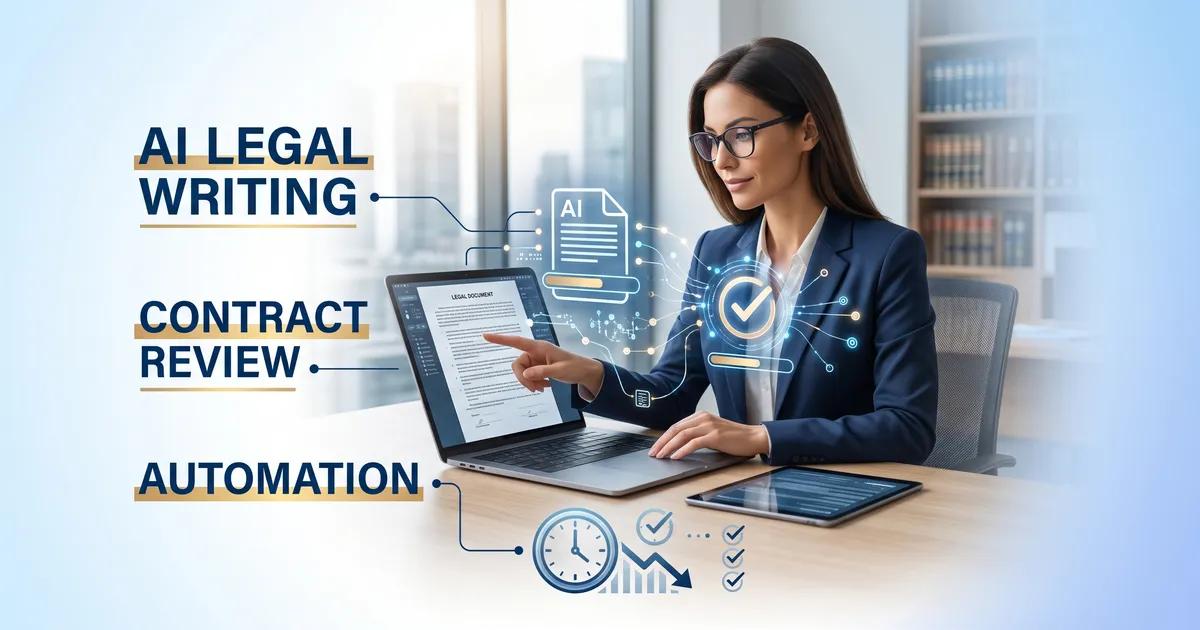
Generative AI models like GPT-4, Claude, and specialized legal AI platforms can now draft, review, and analyze legal documents with accuracy that rivals junior associates—and do it in seconds instead of hours.
The impact? Attorneys cut writing time by 60-70% while improving quality. Contracts reviewed in minutes instead of hours. Risk flags identified automatically. Clauses compared across versions in real-time.
Use Case 1: Contract Drafting – From Blank Page to Polished Document
Instead of starting from scratch or hunting through templates, generative AI drafts contracts based on simple prompts. Provide:
• Client type: "NDA for tech startup acquisition"
• Key terms: "Non-compete for 2 years, territory: North America"
• Preferences: "Defensive language favoring our client"
Result: AI generates a complete NDA in 60 seconds. Attorneys review, adjust, and send. What took 2 hours now takes 15 minutes.
Real example: A corporate law firm using Claude for contract drafting reports 3 hours saved per contract. For 100 contracts annually, that's 300 billable hours recovered—or $45,000+ in recaptured revenue.
Use Case 2: Contract Review & Risk Analysis
Contract review is where AI shines brightest. Upload a contract, and AI instantly:
• Identifies critical clauses: Payment terms, liability caps, termination rights
• Flags unusual provisions: One-sided indemnification, unfavorable renewal terms
• Compares versions: Highlights changes between drafts
• Summarizes key risks: "This contract exposes you to $500K+ liability"
• Suggests language: "Strengthen IP protections with this clause"
Platforms like LexisNexis+ AI, Thomson Reuters Westlaw AI-Assisted Research, and Casetext CoCounsel are built specifically for this. They understand legal language nuances, precedent, and jurisdiction-specific rules.
Use Case 3: Legal Writing & Motion Drafting
AI generates first drafts of motions, briefs, and legal memos. Instead of blank-page panic, attorneys get:
• Structured arguments with citations and case law
• Jurisdiction-specific language compliant with local court rules
• Multiple drafting styles (aggressive, conservative, balanced)
• Supporting case law and precedent integrated
Example: A motion opposing summary judgment that would take 4-6 hours to draft from scratch? AI delivers a complete draft in 10 minutes—with proper formatting, argument structure, and citations. Attorneys edit and personalize rather than create from zero.
Implementation: Step-by-Step for Your Firm
Step 1: Choose Your Platform (2-3 weeks)
Options include:
• Specialized legal AI: LexisNexis+ AI, Thomson Reuters, Casetext, Harvey AI
• General-purpose AI with prompting: ChatGPT Plus (with careful prompt engineering), Claude
• Hybrid approach: Specialized AI for contract review + general AI for drafting
Step 2: Develop Prompts & Templates (1-2 weeks)
Create firm-specific prompts for common documents:
• "Draft an NDA for [client type] with [key terms]"
• "Review this contract and flag risks in [practice area]"
• "Generate a summary of key provisions for [contract type]"
Step 3: Pilot with 2-3 Attorneys (2-4 weeks)
Test on 20-30 documents. Measure:
• Time saved per document
• Quality of AI output (requires attorney review?)
• Confidence in AI suggestions
• Integration with existing workflows
Step 4: Roll Out Firm-Wide with Training (2-3 weeks)
Train all attorneys on:
• Prompt best practices
• Quality assurance processes
• When to use AI vs. manual drafting
• Ethical considerations (disclosure, accuracy, bias)
Expected ROI: The Numbers That Matter
For a 10-attorney firm:
Average annual AI cost: $5,000-$15,000 (platforms + subscription)
Time saved per attorney annually: 200-300 hours
Value at $200/hour billing rate: $40,000-$60,000 per attorney
Firm total ROI: $400,000-$600,000 annually
For a 50-attorney firm:
Annual cost: $20,000-$40,000
Time saved (firm-wide): 10,000-15,000 hours
Annual value: $2,000,000-$3,000,000
Most firms see ROI within 2-4 weeks of implementation.
Critical Considerations: The Caveats
1. Always review AI output. Generative AI hallucinates citations and can misinterpret nuanced legal language. Attorney review is mandatory—never submit AI-drafted documents without verification.
2. Disclose AI use appropriately. Some jurisdictions require disclosure that AI was used. Check your bar association rules and client engagement letters.
3. Protect client confidentiality. Never upload confidential client information to public AI platforms (like free ChatGPT). Use enterprise versions with data privacy guarantees (ChatGPT Enterprise, Claude API) or specialized legal platforms that comply with attorney-client privilege.
4. Train your team. Garbage in = garbage out. Quality prompts and proper workflows are essential. Invest in training.
5. Start narrow, expand gradually. Begin with low-stakes documents (templates, memos, research summaries). Expand to higher-stakes work (contracts, motions) only after proving accuracy and building confidence.
The Future: AI That Understands Law
The next generation of legal AI will go deeper:
• Predictive analytics: AI predicts case outcomes based on jurisdiction, judge, opposing counsel
• Real-time contract analysis: Upload contracts, get instant risk scores and comparisons to industry standards
• Automated due diligence: AI performs M&A due diligence in hours instead of weeks
• Jurisdiction-specific compliance: AI ensures every document complies with local regulations
Firms adopting AI now will have massive competitive advantages by 2027.
Bottom Line: AI Isn't Replacing Lawyers—It's Amplifying Them
Generative AI for legal writing and contract review isn't about replacing attorneys. It's about freeing them from time-consuming, repetitive work so they can focus on strategy, client relationships, and high-value tasks that only human lawyers can do.
The firms winning in 2026 won't be those resisting AI. They'll be those who implement it strategically, train their teams properly, and use the recovered time to serve clients better and grow more profitably.
Start with one document type. Measure the time savings. Expand from there. The ROI is undeniable.