
AI Compliance for Law Firms: Avoid Malpractice Risk
Implement responsible AI governance to reduce malpractice risk. Verify AI outputs, document AI use, protect client data.
Author: App Wizard
Published on March 11, 2026
Share this article
Share with your network or copy the link
The AI Malpractice Crisis Facing Law Firms
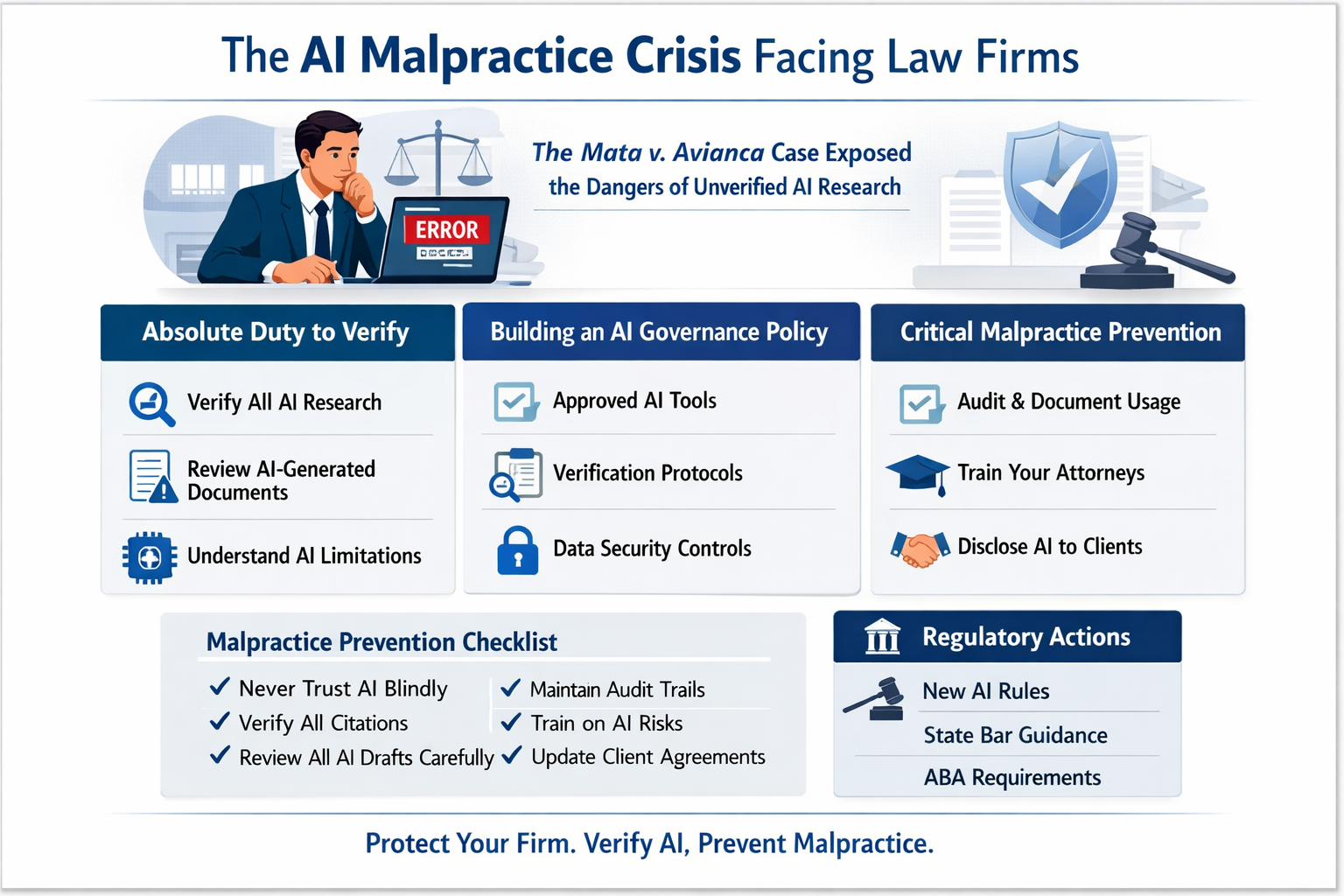
In 2024, the Mata v. Avianca case sent shockwaves through the legal profession. An attorney used ChatGPT to research a case, and the AI generated entirely fabricated legal citations. The consequences were severe: sanctions, professional discipline, and reputational damage. This case exposed a critical reality: lawyers using unverified AI face malpractice liability.
The "Absolute Duty to Verify" Rule
Professional responsibility rules now impose an absolute duty to verify all AI-generated content before presenting it to courts or clients. This means:
1. Verify All AI Research: Never cite legal authorities without checking original sources. AI hallucinations (fabricated cases, false statutes) are common.
2. Review AI-Generated Documents: AI drafts can contain errors, missing provisions, and contradictions. Always review thoroughly before sending to clients.
3. Understand AI Limitations: AI is excellent at pattern matching but poor at nuanced legal judgment, ethical analysis, and complex reasoning.
4. Document AI Usage: Maintain records of where AI was used and how it was verified. This protects you in malpractice claims.
Building an AI Governance Policy
Progressive law firms now implement formal AI governance policies addressing:
Approved AI Tools: Create a whitelist of pre-vetted legal AI tools (ChatGPT for brainstorming, LexisNexis+ AI for research, CoCounsel for document review).
Use Cases & Restrictions: Define where AI is safe to use (drafting templates, brainstorming, research starting point) vs. where it's prohibited (citation generation, final legal opinions).
Verification Protocols: Establish mandatory verification steps before any AI output reaches clients or courts.
Data Security: Never input client confidential information into public AI systems. Use enterprise or on-premises AI only for sensitive matters.
Training Requirements: All attorneys must understand AI capabilities, limitations, and risks. One Mata-type incident can destroy a firm's reputation.
Critical Malpractice Prevention Checklist
✓ Never cite legal authorities generated by AI without verifying original sources
✓ Review all AI-generated drafts thoroughly before client delivery
✓ Maintain audit trails documenting AI usage and verification steps
✓ Implement access controls—restrict AI to non-confidential matters
✓ Train all staff on AI limitations and malpractice risks
✓ Disclose AI usage to clients when appropriate
✓ Consider AI liability insurance coverage
✓ Update client agreements addressing AI usage
What Bar Associations Are Doing
State bars are increasing enforcement and discipline for improper AI use. Recent actions include:
North Carolina: Expanded AI guidance requiring firms to implement governance policies.
New York: Added AI-specific requirements to professional conduct rules.
ABA Model Rules: The American Bar Association now explicitly requires competence with AI and understanding of AI risks.
If your state bar hasn't yet issued AI guidance, they will in 2026. Firms that proactively implement governance policies position themselves favorably with regulators.
The Bottom Line
AI is transformative for law firms, but only when implemented responsibly. The firms that survive the next 2-3 years will be those that:
• Embrace AI for productivity gains while maintaining absolute verification standards
• Invest in attorney training and governance systems
• Document responsible AI usage meticulously
• Stay ahead of evolving regulatory requirements
Your AI Governance Action Plan
This Month: Assess which AI tools your firm is currently using and identify any gaps in verification processes.
Next Month: Create an AI governance policy specific to your practice areas and use cases.
Within 3 Months: Train all attorneys and staff on the policy. Make AI governance part of your quality assurance processes.
Conclusion
The AI revolution is unavoidable—but the malpractice crisis is preventable. By implementing responsible AI governance, verifying outputs, and maintaining meticulous documentation, you'll gain the productivity benefits of AI while protecting your firm from liability. The lawyers who understand this dynamic will lead their markets in 2026.