
10 Strategies to Boost Website Conversions
Double your conversion rate with proven tactics: simplify forms, add social proof, optimize CTAs, reduce friction, and A/B test everything.
Author: App Wizard
Published on December 28, 2025
Share this article
Share with your network or copy the link
The Conversion Rate Benchmark for Law Firms
The average law firm website converts at 1-2%. Top-performing law firms achieve 3-5% conversion rates. The difference is optimization. A 2x improvement in conversion rate (from 2% to 4%) with the same traffic means 2x more client inquiries.
Strategy 1: Audit Your Current Conversion Funnel
Before optimizing, understand where visitors are dropping off: Use Google Analytics to track the visitor journey, identify which pages have the highest bounce rate, track form abandonment rate and which fields are completed, and record heatmaps to see where visitors click and scroll.
Strategy 2: Simplify Your Forms
Every form field you add decreases completion rate. Minimum fields should be Name, Email, Phone, and Practice Area. Use progressive profiling—ask basic questions first, detailed questions later through email or phone.
Strategy 3: Create Multiple Paths to Contact
Different visitors convert through different channels: phone number in header and footer (clickable on mobile), contact form on multiple pages, chat functionality for immediate questions, and prominent appointment scheduling button.
Strategy 4: Leverage Social Proof Aggressively
Social proof is one of the most powerful conversion drivers: Display review ratings prominently (Google, Avvo, Justia), feature video testimonials on your homepage, showcase specific case results (with permission), and display awards and recognition (Super Lawyers, Best Lawyers).
Strategy 5: Optimize Your Value Proposition
Your unique value proposition should answer: "Why choose your firm over others?" Examples include "12+ years of experience, $25M+ recovered," "Former insurance company attorney (you get someone who knows their tactics)," "No recovery, no fees," and "Personalized attention, not assembly-line treatment."
Strategy 6: Speed Up Your Website
Page speed directly impacts conversion. Slow pages = bounced visitors. Test current speed on Google PageSpeed Insights, compress images and use modern formats, enable browser caching and minimize CSS/JavaScript, consider a content delivery network (CDN), and target under 3 seconds on mobile and 2 seconds on desktop.
Strategy 7: Reduce Friction in the Conversion Process
Make it dead simple to take the next step: One-click form submission where possible, inline form validation (tell them what's wrong immediately), show progress on multi-step forms, auto-populate fields when possible, and clearly communicate next steps ("You'll hear from us within 2 hours").
Strategy 8: Personalize the Experience
Different visitor segments need different messages: Show different content based on traffic source, highlight relevant practice areas based on page visited, use retargeting ads to show relevant messaging, and send personalized follow-up emails based on the problem they inquired about.
Strategy 9: Use Urgency and Scarcity (Ethically)
Create urgency without being deceptive: "Limited consultation spots available this month," "Statute of limitations: 2 years to file," countdown timers for consultations, and "Book your consultation before this offer ends."
Strategy 10: Continuous Testing and Optimization
The best way to improve conversion is systematic testing: A/B test headlines, CTAs, forms, and images; test one element at a time to isolate impact; calculate statistical significance before declaring a winner; and implement winning variations and keep testing.
Quick Wins to Implement Today
• Add your top 3 Google reviews to your homepage
• Create a prominent "Free Consultation" button
• Reduce your contact form to 4 fields or fewer
• Add a phone number to your website header
• Create a video testimonial (if you have a client willing to record)
Measuring Success
Track these metrics before and after optimization: overall conversion rate, conversion rate by traffic source, form completion rate, quality of leads (% that become paying clients), and average response time to inquiries.
Conclusion
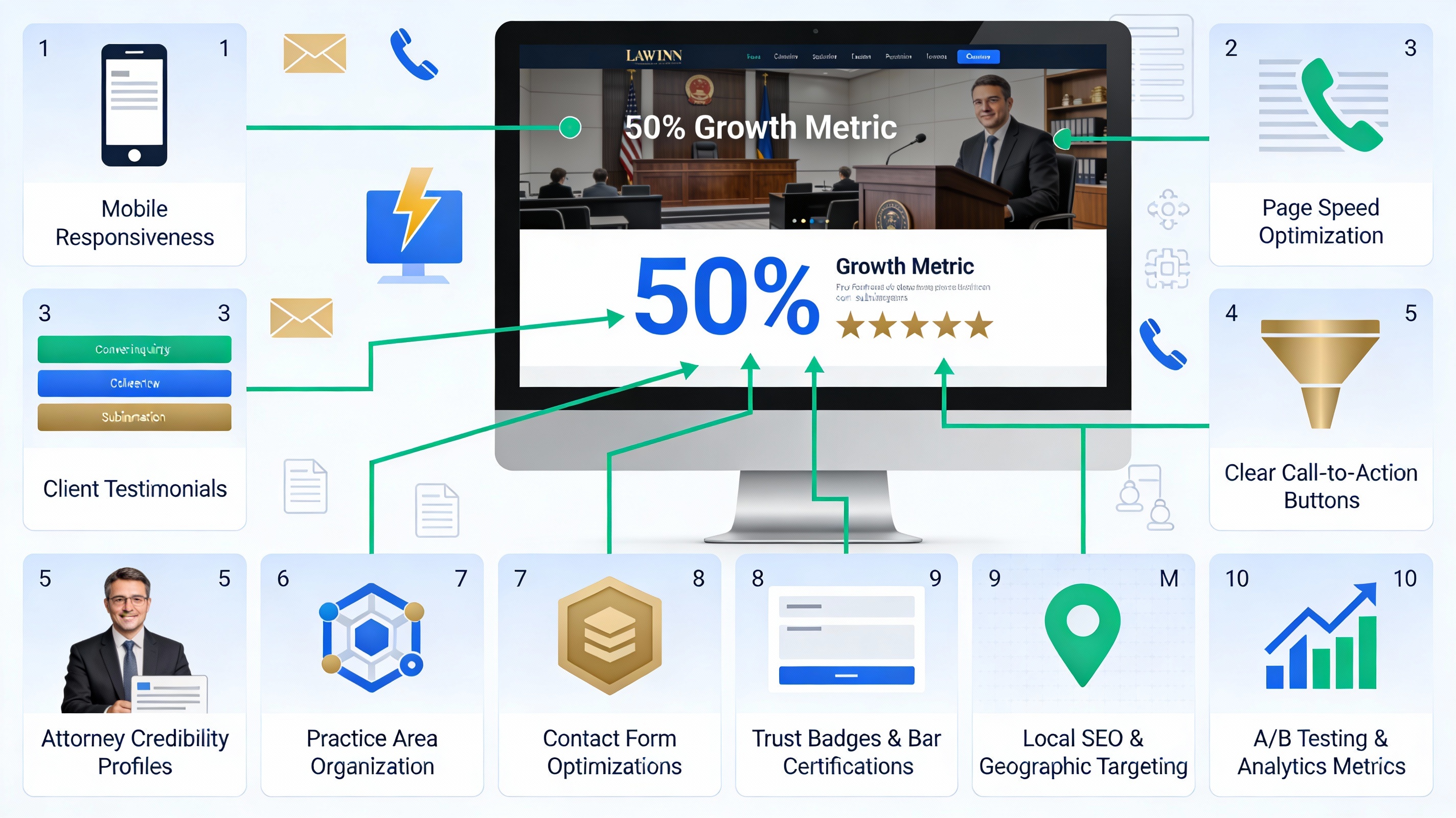
Website optimization is an ongoing process, not a one-time project. By systematically implementing these 10 strategies and continuously testing, you can realistically improve your conversion rate by 50% or more. That doubles your inquiry rate without spending a dime more on marketing.